What Is Vaginal Discharge and How Does It Change Throughout Your Cycle?
Vaginal discharge is normal and changes through your cycle. Learn what each colour and texture may mean, healthy hygiene habits and when to see a doctor.
By Nitya Health Editorial Team7 min read

Vaginal discharge is one of the most normal things a body does — and yet many of us grew up never talking about it. If you have ever noticed a white mark in your underwear and quietly worried, you are far from alone. The good news is that discharge is usually a sign that your vagina is healthy and doing its job.
Discharge also changes in a fairly predictable way across your menstrual cycle. Once you know the pattern, those changes stop being confusing and start telling you useful things — about where you are in your cycle, your fertile days, and when something might need a doctor’s attention.
What is vaginal discharge?
Vaginal discharge is a mix of fluid and cells made by the cervix and the walls of the vagina. It contains water, mucus, old cells and the “good” bacteria (mainly lactobacilli) that keep the vagina slightly acidic.
That fluid has several important jobs:
- Self-cleaning — it carries old cells and bacteria out of the body
- Protection — the acidic environment and good bacteria help keep harmful germs in check
- Moisture — it keeps the vaginal tissues comfortable and supple
- Fertility — around ovulation, cervical mucus helps sperm move towards the egg
Healthy discharge is usually clear to white or off-white, has a mild smell or no smell at all, and does not cause itching or burning. The amount varies from person to person — some people notice very little, others need a panty liner on some days. Both can be normal.
How discharge changes through your cycle
The main driver of these changes is estrogen, which rises before ovulation, and progesterone, which takes over after ovulation. Here is what many people notice in a typical 28-day cycle (your days may shift if your cycle is shorter or longer).
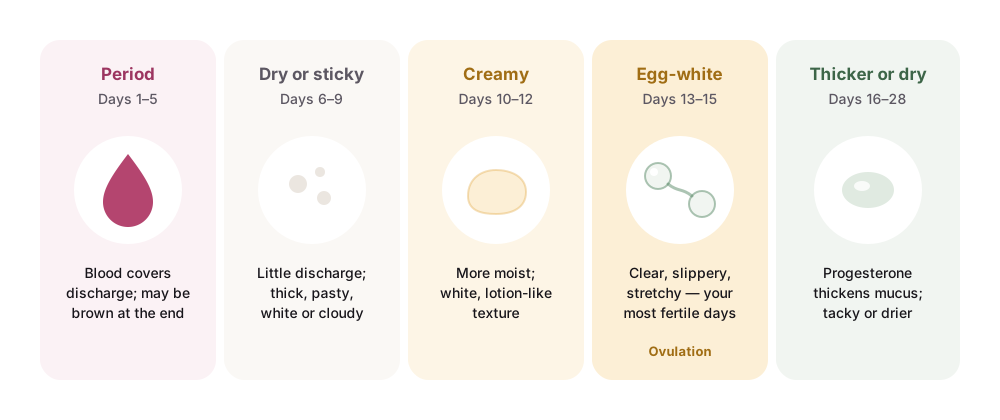
During your period (around days 1–5)
Menstrual blood covers any discharge during your period. Towards the last day or two, you may see brownish discharge — this is simply older blood leaving slowly. Read more in our guide to dark brown period blood.
Just after your period: dry or sticky (around days 6–9)
Estrogen is still fairly low, so many people feel quite dry for a few days. Any discharge tends to be small in amount, thick, sticky or slightly pasty, and white or cloudy.
Creamy and lotion-like (around days 10–12)
As estrogen climbs, discharge increases. It often becomes creamy, white or pale yellow on underwear, and feels moist. It may look a little like hand lotion.
Egg-white around ovulation (around days 13–15)
At peak estrogen, discharge becomes clear, slippery and stretchy — very similar to raw egg white. You may be able to stretch it a few centimetres between your fingers. There is often more of it, and you may feel noticeably wet. This “fertile-quality” mucus is one of the clearest signs of ovulation.
Thicker or drier in the luteal phase (around days 16–28)
After ovulation, progesterone makes cervical mucus thicker and stickier, which helps block sperm and germs. Many people feel drier again, or notice cloudy, tacky discharge. Some notice a little more creamy discharge just before their period.
Tip: The pattern is more important than any single day. Noticing your discharge for two or three cycles — even a quick note each day — makes it much easier to tell what is normal for you and to spot a genuine change.
What different colours and textures may mean
Colour and texture can give helpful clues, but they are not a diagnosis. Many changes are harmless, and infections can look different from person to person.
| Colour / texture | What it may mean | Usually normal? |
|---|---|---|
| Clear and watery | Normal at many points in the cycle; often more after exercise or arousal | Yes |
| Clear and stretchy | Around ovulation, fertile-quality mucus | Yes |
| White or off-white, creamy | Before or after ovulation, normal | Yes, if no itching or smell |
| Thick, white and clumpy (like cottage cheese) | May suggest a yeast infection, especially with itching or redness | See a doctor if new or recurring |
| Pale yellow, no symptoms | Can be normal, especially as it dries on underwear | Often yes |
| Yellow or green, frothy or smelly | May suggest an infection such as trichomoniasis or another sexually transmitted infection | See a doctor |
| Grey or thin with a fishy smell | May suggest bacterial vaginosis (BV), particularly after sex | See a doctor |
| Brown | Usually old blood at the start or end of a period; occasionally spotting | Usually yes; check if frequent |
| Pink | Light spotting — possibly around ovulation, after sex, or early pregnancy | Often; see a doctor if it keeps happening |
If you notice bleeding or pink discharge after menopause, always see a doctor, even if it is only a small amount.
Discharge in pregnancy and on hormonal contraception
During pregnancy
Many people notice more discharge in pregnancy. This is often called leukorrhoea — thin, white or milky discharge with a mild smell. Higher estrogen and increased blood flow to the pelvic area are thought to be responsible. Some people notice an increase in discharge as an early sign, even before a missed period.
Late in pregnancy, a thick, jelly-like plug of mucus (sometimes streaked with blood) may come away as the cervix prepares for labour. Any watery gush or steady trickle, bleeding, or discharge with a bad smell during pregnancy should be checked by your doctor promptly.
On hormonal contraception
Combined pills, the hormonal IUD (coil), the implant and the injection can all change your discharge pattern. Because many of these methods prevent ovulation or thicken cervical mucus, you may not see the egg-white phase at all, and your discharge may stay similar through the month. Some people notice slightly more discharge, others less. Spotting, especially in the first few months of a new method, is also common.
Healthy intimate hygiene: dos and don’ts
The vagina has its own careful balance of bacteria and acidity. Most intimate hygiene is about not disturbing it.
Do
- Wash the vulva (the outside) with plain water once or twice a day; a mild, unperfumed soap on the outer skin only is fine if you prefer
- Wipe from front to back after using the toilet
- Wear breathable cotton underwear and change out of damp gym clothes or swimwear soon
- Change pads every 4–6 hours (sooner if heavy), and do not leave a tampon in longer than the pack advises
- Use condoms with new partners to reduce the risk of infections that change discharge
Don’t
- Don’t douche or rinse inside the vagina — this washes away protective bacteria and is linked to a higher risk of infections such as BV
- Don’t use scented washes, sprays, wipes or talc in the intimate area
- Don’t use daily panty liners all the time unless you need them — they can trap heat and moisture; if you use them, choose unscented and change them often
- Don’t self-treat repeatedly with over-the-counter antifungal creams; if symptoms keep coming back, a proper diagnosis matters
Many of us were taught that discharge means we are “not clean”. It does not. A vagina with discharge is a vagina that is working well.
Keeping track of your pattern
Your discharge is personal. Age, stress, illness, breastfeeding, some medicines and changes in contraception can all shift it. Paying attention over a few cycles helps you learn your own baseline. Logging discharge alongside your period and symptoms in an app like Nitya Health makes it easier to spot when something has genuinely changed — and gives you clear notes to share if you need to see a doctor.
When to see a doctor
Discharge on its own is usually nothing to worry about. Book an appointment with a gynaecologist or your family doctor if you notice:
- A strong, unpleasant or fishy smell
- Itching, burning, soreness or swelling in or around the vagina
- A sudden change in colour — especially yellow, green or grey
- A frothy, very watery or cottage-cheese-like texture that is new for you
- Pain in the lower abdomen or pelvis, pain during sex, or burning when you pass urine
- Fever along with unusual discharge
- Bleeding between periods, after sex or after menopause
- Unusual discharge or leaking fluid during pregnancy
Most causes of abnormal discharge — such as yeast infections, bacterial vaginosis and sexually transmitted infections — are common and very treatable. There is no need to feel embarrassed: doctors see these concerns every day, and getting checked early is the quickest way to feel comfortable again.
Frequently asked questions
Is it normal to have discharge every day?
Yes. Most people with a vagina have some discharge on most days, and the amount varies through the cycle. A small, steady amount of clear or white discharge without a strong smell or itching is usually a sign of a healthy vagina.
Why is my discharge stretchy like egg white?
Clear, slippery, stretchy discharge usually appears in the days around ovulation, when estrogen is at its highest. It helps sperm travel through the cervix, so it is a useful sign of your fertile window.
Should I wash inside my vagina to keep it clean?
No. The vagina cleans itself, and douching or washing inside can upset its natural balance and make infections more likely. Plain water on the outer area (the vulva) is enough for most people.
When is discharge a sign of infection?
Discharge may point to an infection if it suddenly changes colour (yellow, green or grey), smells strongly or fishy, looks frothy or like cottage cheese, or comes with itching, burning, pain or soreness. A doctor can examine you and confirm the cause.
- #vaginal discharge
- #cervical mucus
- #intimate hygiene
- #ovulation
- #menstrual cycle
Track it with Nitya Health
Log your cycle, symptoms and habits — and get answers from an AI health coach.