Circadian Rhythm: How Your Body Clock Affects Sleep, Hormones and Periods
What is the circadian rhythm, how does your body clock work, and how does it affect sleep, hormones and your menstrual cycle? Plus simple ways to reset it.
By Nitya Health Editorial Team9 min read
Have you noticed that you feel sleepy at roughly the same time every night, or hungry at the same time every afternoon — even without looking at the clock? That is your circadian rhythm at work.
Your circadian rhythm is the body’s internal 24-hour clock. It quietly controls when you feel alert or tired, when key hormones are released, how well you digest food and even how your body temperature changes through the day. When it runs smoothly, you sleep well and feel steady. When it is thrown off — by late nights, screens, shift work or travel — almost every system in the body feels it, including your menstrual cycle.
In this guide, we explain how your body clock works, what disrupts it, how it connects to women’s hormones and simple, practical ways to keep it on track.
What is the circadian rhythm?
The word circadian comes from the Latin circa diem, meaning “about a day”. Circadian rhythms are physical, mental and behavioural changes that follow a roughly 24-hour cycle.
The master clock sits in a tiny cluster of about 20,000 nerve cells in the brain called the suprachiasmatic nucleus (SCN), located in the hypothalamus just above where the optic nerves cross. But it is not the only clock. Almost every organ — the liver, gut, heart, fat tissue and ovaries — has its own “peripheral clock”. The SCN acts like a conductor, keeping all these clocks playing in time.
Left completely alone, without daylight, the human body clock runs slightly longer than 24 hours — on average about 24 hours and 10–15 minutes. That is why it needs to be reset every day by signals from the outside world.
The 2017 Nobel Prize in Physiology or Medicine was awarded to Jeffrey Hall, Michael Rosbash and Michael Young for discovering the genes and proteins that keep this internal clock ticking inside our cells.
How your body clock is set: light and other cues
The signals that reset your body clock are called zeitgebers — German for “time givers”.
- Light is by far the strongest. Special light-sensitive cells in the retina detect brightness (especially blue-rich daylight) and send a direct message to the SCN. Morning light tells the clock “the day has started”; darkness in the evening allows melatonin to rise.
- Meal timing sets the clocks in your liver and gut. Eating at very irregular times — or late at night — can put these organs out of step with the brain.
- Physical activity helps strengthen daily rhythms, particularly when done in daylight.
- Social routine — fixed work, school and family schedules — keeps your sleep and wake times consistent.
A typical day on your body clock
For someone who sleeps from about 10:30 pm to 6:30 am, the body clock follows a fairly predictable pattern:
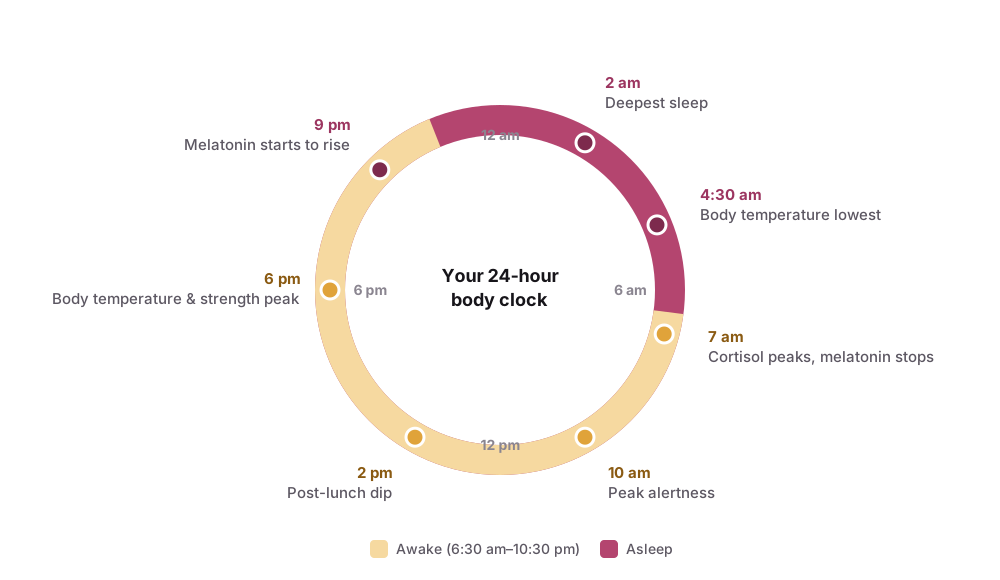
| Time (approx.) | What your body is doing |
|---|---|
| 4–5 am | Core body temperature is at its lowest |
| 6–8 am | Melatonin switches off; cortisol peaks within 30–45 minutes of waking |
| 9–11 am | Alertness and concentration are usually high |
| 1–3 pm | A natural dip in energy — the “post-lunch slump” |
| 4–7 pm | Body temperature, reaction time and muscle strength peak |
| 8–10 pm | Melatonin starts rising as light fades |
| 1–3 am | Deepest stage of sleep for most people |
Two hormones that run the show
- Melatonin is released by the pineal gland when it gets dark. It does not knock you out like a sleeping pill — it signals to the body that night has arrived. Bright light in the evening, including from phones and LED screens, can delay its release.
- Cortisol rises in the early morning to help you wake up, mobilise energy and feel alert, then gradually falls through the day. Chronic stress or poor sleep can flatten this healthy curve, leaving you tired in the morning and “wired” at night.
Are you a morning person or a night owl?
Not everyone’s clock runs on the same timetable. Your natural preference for sleep and wake times is called your chronotype.
- Morning types (“larks”) wake easily, feel best early in the day and get sleepy early in the evening.
- Evening types (“owls”) struggle with early mornings and feel most alert in the late evening.
- Most people fall somewhere in between.
Chronotype is partly genetic and also changes with age — teenagers and young adults tend to be night owls, while older adults usually shift earlier. Being an owl is not a problem in itself. Trouble starts when your daily schedule constantly fights your clock, a mismatch sometimes called “social jet lag”: sleeping late on weekends and waking early on weekdays is like flying across time zones every week.
Signs your circadian rhythm is out of sync
- Difficulty falling asleep at night, even when tired
- Waking up exhausted despite enough hours in bed
- Feeling sleepy during the day and alert late at night
- Needing an alarm and several cups of chai or coffee to get going
- Irregular hunger, late-night cravings or digestive upset
- Low mood, irritability or poor concentration
- Changes in your period — irregular cycles or worse PMS
What disrupts your body clock?
Modern life makes it easy to drift out of rhythm. Common culprits include:
- Screens at night. Scrolling in bed exposes your eyes to bright light exactly when melatonin should be rising.
- Too little daylight. Spending the day indoors under dim lighting gives your clock a weak “daytime” signal.
- Late dinners. In many Indian homes dinner is eaten at 9:30 or 10 pm, close to bedtime. Eating late can raise blood sugar more than the same meal eaten earlier and may disturb sleep.
- Irregular sleep schedules, especially very late weekends.
- Night shifts and rotating shifts — common for nurses, doctors, call-centre and IT staff working with other time zones.
- Travel across time zones (jet lag).
- Caffeine late in the day, which can stay in the body for 5–6 hours or more.
- Life stages such as pregnancy, caring for a newborn and menopause.
Circadian rhythm and women’s hormones
Your body clock and your reproductive hormones are closely connected. The brain area that controls sleep timing sits right next to the area that releases the hormones driving your menstrual cycle, and the ovaries and uterus have their own clock genes.
Your cycle and your sleep
Hormones change across your menstrual cycle phases, and so can your sleep:
- In the luteal phase (after ovulation), progesterone raises your body temperature by about 0.3–0.5°C. A warmer body can make it harder to fall and stay asleep.
- In the days before your period, falling estrogen and progesterone can bring lighter, more broken sleep, vivid dreams and daytime tiredness. This is common in people with PMS and especially PMDD.
- During your period, cramps and heavy flow can wake you at night.
How a disturbed body clock can affect your cycle
Research — much of it in nurses and other shift workers — has found that long-term circadian disruption is linked with:
- Irregular or longer cycles
- More painful periods and stronger PMS symptoms
- Changes in ovulation and, in some studies, longer time to conceive
- A possible link with PCOS: women with PCOS more often report poor sleep, and disrupted sleep can worsen insulin resistance, which drives many PCOS symptoms
These are associations, not proof that poor sleep alone causes period problems. But if your periods have become irregular, it is worth looking at your sleep and daily routine alongside other causes — our guide to irregular periods and their causes covers the full list.
Pregnancy and menopause
During pregnancy, physical discomfort, frequent urination and hormonal changes often disturb sleep, especially in the third trimester. In perimenopause and menopause, hot flushes and night sweats can wake you repeatedly, and lower estrogen can make sleep lighter. A steady routine, a cool bedroom and morning light can help in both stages.
How to reset and support your circadian rhythm
The good news is that your body clock responds well to consistent habits. You can usually shift it by about an hour a day.
1. Get morning light
Step outside within an hour of waking for 10–30 minutes — on your balcony, terrace or a short walk. Outdoor light, even on a cloudy day, is far brighter than indoor lighting. This is the single most powerful way to anchor your clock.
2. Keep a fixed wake-up time
Wake up at roughly the same time every day, including weekends (within about an hour). A consistent wake time matters even more than a fixed bedtime.
3. Dim the lights in the evening
For 1–2 hours before bed, switch to warm, low lighting. Turn on night mode on your phone, lower the brightness and try to put screens away at least 30–60 minutes before sleep.
4. Eat earlier and at regular times
- Try to finish dinner 2–3 hours before bedtime.
- Keep meal times regular, with a good breakfast and a lighter dinner — dal, sabzi and roti or a khichdi rather than a heavy late meal.
- If you have PCOS, regular, earlier meals may also help with blood sugar — see our PCOS diet chart for ideas.
5. Time your caffeine
Enjoy your chai or coffee in the morning and early afternoon, and avoid it after about 2–3 pm if you have trouble sleeping.
6. Move during the day
Regular exercise improves sleep quality. Morning or daytime activity outdoors gives a double benefit of movement and light. Avoid very intense workouts in the hour before bed if they leave you wired.
7. Make your bedroom sleep-friendly
Keep it dark, quiet and cool. Blackout curtains, an eye mask or earplugs can help, especially in busy cities with streetlights and traffic noise.
8. If you work night shifts
- Keep your sleep schedule as consistent as possible, even on days off.
- Wear dark glasses on the way home after a night shift to reduce morning light exposure.
- Sleep in a fully darkened room and protect your sleep time from interruptions.
- Avoid heavy meals in the middle of the night; have a light snack instead.
Track the pattern. Logging your sleep, energy and mood alongside your period in an app like Nitya Health can reveal how your body clock and cycle affect each other — for example, whether poor sleep weeks line up with longer cycles or worse PMS.
What about melatonin supplements?
Melatonin can be useful for jet lag or for people whose sleep timing is significantly delayed, but it is not a cure-all for insomnia, and higher doses are not better. Timing matters: taken at the wrong time, it can shift your clock in the wrong direction.
Talk to a doctor before taking melatonin, particularly if you are pregnant, trying to conceive, breastfeeding, or taking other medicines such as blood thinners, antidepressants or diabetes medication.
When to see a doctor
Speak to a doctor if:
- You have trouble sleeping at least three nights a week for more than three months
- You feel very sleepy during the day, or fall asleep while reading, watching TV or driving
- You snore loudly, gasp or stop breathing during sleep (signs of sleep apnoea)
- Low mood, anxiety or irritability are affecting your daily life
- Your periods have become irregular, very painful or have stopped
- Sleep problems are significantly worse before your period, which may point to PMDD
Sleep problems often have treatable causes, including thyroid disorders, anaemia, depression, sleep apnoea and hormonal conditions. A good night’s sleep is not a luxury — it is one of the foundations of hormonal health.
Frequently asked questions
What is the circadian rhythm in simple words?
It is your body's internal 24-hour clock. A small area of the brain uses daylight and darkness to decide when you feel alert or sleepy, when hormones like cortisol and melatonin are released, and when you digest food best.
How long does it take to reset your circadian rhythm?
Most people can shift their body clock by about an hour a day. Small changes in sleep timing settle within a few days, while a big shift — such as after night shifts or long-haul travel — can take one to two weeks of consistent wake times and morning light.
Can a disturbed circadian rhythm affect periods?
Yes, it can. Studies of night-shift workers and people with very irregular sleep show higher rates of irregular cycles and more painful periods. Your sleep-wake rhythm and reproductive hormones are linked, so long-term disruption can show up in your cycle.
Is it bad to sleep late if I still get 8 hours?
Getting enough sleep matters most, but timing matters too. Sleeping very late often means less morning light, late meals and irregular weekends, which can push your body clock out of step. A consistent schedule is healthier than a shifting one, even if total hours are the same.
Should I take melatonin to fix my sleep?
Melatonin can help with jet lag or certain sleep-timing problems, but it is not a general sleeping pill and the right dose and timing matter. Talk to a doctor before taking it, especially if you are pregnant, breastfeeding or on other medicines.
- #circadian rhythm
- #sleep
- #hormones
- #melatonin
- #menstrual cycle
Track it with Nitya Health
Log your cycle, symptoms and habits — and get answers from an AI health coach.