Pregnancy Weeks to Months: How Far Along Are You?
Convert pregnancy weeks to months and trimesters with a simple chart, learn how doctors date a pregnancy and work out your due date from your last period.
By Nitya Health Editorial Team8 min read
“How many weeks are you?” is one of the first questions you will hear once you share your pregnancy news — and one of the most confusing to answer. Doctors talk in weeks, family members talk in months, and the two do not line up neatly. Add trimesters to the mix and it is easy to feel unsure of exactly how far along you are.
This guide explains how pregnancy is dated, why “nine months” is really a little longer, how to work out your due date, and includes a full week-by-week conversion chart you can come back to throughout your pregnancy.
How pregnancy is dated
Pregnancy is counted from the first day of your last menstrual period (LMP) — not from the day you conceived. This can seem strange, because you were not actually pregnant at that point. But most people know when their last period started, while very few know the exact day they ovulated or conceived. Using the LMP gives doctors a consistent starting point.
In a typical 28-day cycle, ovulation happens around two weeks after the period starts. So by the time you conceive, you are already counted as being about two weeks pregnant.
Gestational age vs fetal age
- Gestational age is the age of the pregnancy counted from your LMP. This is the number your gynaecologist, scan reports and antenatal card will use.
- Fetal age (or conceptional age) is the actual age of the baby, counted from conception. It is roughly two weeks less than the gestational age.
So if your report says you are 12 weeks pregnant, the baby has been developing for about 10 weeks. Unless someone says otherwise, “weeks pregnant” always means gestational age.
Why “9 months” is really 9 months and a week
A full-term pregnancy is counted as 40 weeks, or 280 days, from the LMP. Calendar months average about 4.3 weeks each, so nine calendar months come to roughly 39 weeks. That leaves about one extra week — which is why many people feel they have been pregnant for “nine and a bit” months by the time the baby arrives.
Remember too that 40 weeks is an estimate. Babies born anywhere from 37 to 42 weeks are considered to be within the normal range, and only a small proportion arrive on their exact due date.
How to calculate your due date
The most common method is Naegele’s rule, which assumes a regular 28-day cycle:
- Take the first day of your last period.
- Add one year.
- Subtract three months.
- Add seven days.
This is the same as adding 280 days to your LMP.
A worked example
Suppose your last period started on 10 January 2026:
- Add one year → 10 January 2027
- Subtract three months → 10 October 2026
- Add seven days → 17 October 2026
Your estimated due date (EDD) would be 17 October 2026. On any given day, you can count the number of full weeks since 10 January to find out how far along you are.
If your cycles are longer or shorter than 28 days, you probably ovulate later or earlier than day 14, and the LMP date may be off by a few days. Let your doctor know your usual cycle length — an early dating scan will usually settle the question.
If you have been logging your periods in a tracker such as the Nitya Health app, you will already have your LMP date and your typical cycle length to hand for your first appointment.
Pregnancy weeks to months conversion chart
There is no single official way to divide 40 weeks into nine months, so you may see slightly different charts elsewhere. The table below uses a widely followed convention, with trimesters as most doctors define them.
| Week of pregnancy | Month | Trimester |
|---|---|---|
| Week 1 | Month 1 | First |
| Week 2 | Month 1 | First |
| Week 3 | Month 1 | First |
| Week 4 | Month 1 | First |
| Week 5 | Month 2 | First |
| Week 6 | Month 2 | First |
| Week 7 | Month 2 | First |
| Week 8 | Month 2 | First |
| Week 9 | Month 3 | First |
| Week 10 | Month 3 | First |
| Week 11 | Month 3 | First |
| Week 12 | Month 3 | First |
| Week 13 | Month 3 | First |
| Week 14 | Month 4 | Second |
| Week 15 | Month 4 | Second |
| Week 16 | Month 4 | Second |
| Week 17 | Month 4 | Second |
| Week 18 | Month 5 | Second |
| Week 19 | Month 5 | Second |
| Week 20 | Month 5 | Second |
| Week 21 | Month 5 | Second |
| Week 22 | Month 5 | Second |
| Week 23 | Month 6 | Second |
| Week 24 | Month 6 | Second |
| Week 25 | Month 6 | Second |
| Week 26 | Month 6 | Second |
| Week 27 | Month 6 | Second |
| Week 28 | Month 7 | Third |
| Week 29 | Month 7 | Third |
| Week 30 | Month 7 | Third |
| Week 31 | Month 7 | Third |
| Week 32 | Month 8 | Third |
| Week 33 | Month 8 | Third |
| Week 34 | Month 8 | Third |
| Week 35 | Month 8 | Third |
| Week 36 | Month 9 | Third |
| Week 37 | Month 9 | Third |
| Week 38 | Month 9 | Third |
| Week 39 | Month 9 | Third |
| Week 40 | Month 9 (due date) | Third |
| Weeks 41–42 | Past due date | Third |
Trimester by trimester: what usually happens
Every pregnancy is different, so treat these as general patterns rather than a checklist.
First trimester (weeks 1–13)
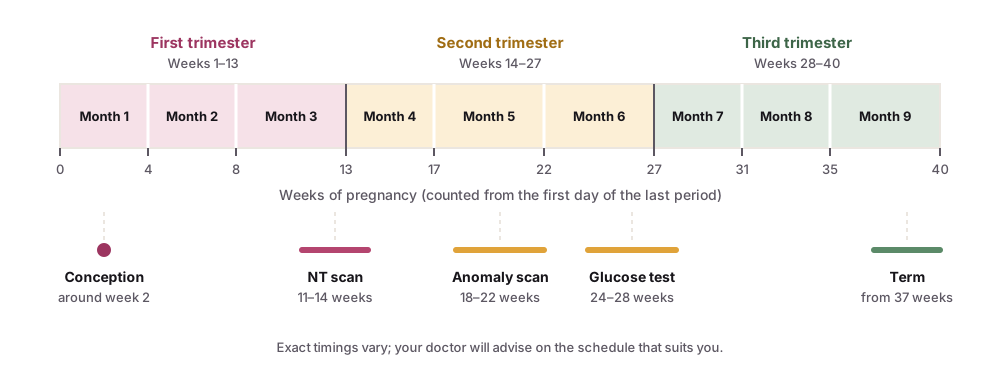
- Month 1 (weeks 1–4): Your period starts, ovulation and conception happen around week 2, and the fertilised egg implants in the uterus. A missed period around week 4 is often the first sign. Some people notice light spotting or mild cramping around implantation.
- Month 2 (weeks 5–8): Early symptoms such as nausea, tiredness, breast tenderness and frequent urination often begin. On an ultrasound, cardiac activity can usually be seen from around six to seven weeks.
- Month 3 (weeks 9–13): From around week 10, the developing baby is called a fetus. The main organs have formed and continue to mature. Many people find nausea starts to ease towards the end of this trimester.
Second trimester (weeks 14–27)
- Month 4 (weeks 14–17): Energy often returns and the bump may begin to show, especially in a second pregnancy.
- Month 5 (weeks 18–22): Many people feel the first flutters of movement (quickening) somewhere around 18–22 weeks, sometimes earlier if they have been pregnant before. The detailed anomaly scan is usually done in this window.
- Month 6 (weeks 23–27): Movements become stronger and more regular. A glucose tolerance test to check for gestational diabetes is commonly done between 24 and 28 weeks.
Third trimester (weeks 28–40+)
- Month 7 (weeks 28–31): The baby gains weight steadily. Check-ups usually become more frequent from here.
- Month 8 (weeks 32–35): You may notice backache, heartburn, breathlessness or practice contractions (Braxton Hicks). Your doctor will start checking the baby’s position.
- Month 9 (weeks 36–40): The baby is getting ready for birth. From 37 weeks a pregnancy is considered term, with 39–40 weeks counted as full term.
Dating scans and why your dates may change
An early ultrasound is the most reliable way to date a pregnancy. In the first trimester, babies grow at a very similar rate, so measuring the length of the baby (the crown–rump length) gives a fairly accurate gestational age.
Your gynaecologist may suggest a dating or viability scan in early pregnancy, and the nuchal translucency (NT) scan between about 11 and 14 weeks, which also forms part of first-trimester screening. If the scan measurement differs from your LMP date by more than about a week, your due date may be revised to match the scan. This is very common, especially if:
- Your cycles are irregular or longer than 28 days
- You are not sure of your last period date
- You conceived while breastfeeding or soon after stopping hormonal contraception
Once your due date has been set from an early scan, it is not normally changed by later scans, even if the baby measures bigger or smaller.
Starting antenatal care
It is a good idea to contact a gynaecologist or your nearest health centre as soon as you get a positive pregnancy test. Early antenatal care helps confirm the pregnancy, date it accurately and pick up any issues early. At your first visits you can expect:
- A confirmation of pregnancy and calculation of your due date
- Blood tests such as haemoglobin, blood group, blood sugar, thyroid function and infection screening
- Blood pressure and weight checks
- Advice on folic acid, and iron and calcium supplements later in pregnancy
- A plan for scans and future visits
Government guidelines in India recommend a minimum of four antenatal visits during pregnancy, and many doctors schedule more, with visits becoming more frequent in the third trimester. Eating well matters too — if you follow a vegetarian diet, our guide to iron-rich vegetarian foods can help you plan meals that support healthy haemoglobin levels.
When to see a doctor
Book your first antenatal appointment as soon as you know you are pregnant. Between visits, contact your doctor or go to the hospital straight away if you notice:
- Vaginal bleeding or leaking fluid at any stage
- Severe or one-sided abdominal pain, especially in early pregnancy
- Severe vomiting that stops you keeping food or water down
- A severe headache, blurred vision or sudden swelling of the face, hands or feet
- Fever, or burning and pain while passing urine
- Fewer movements than usual, or a change in your baby’s pattern of movements, in the later months
- Regular, painful contractions before 37 weeks
You know your body best. If something feels wrong, it is always worth getting checked — your care team would much rather see you and reassure you than have you wait.
Frequently asked questions
How many months is 40 weeks of pregnancy?
Forty weeks is 280 days, which works out to roughly nine calendar months plus about one week. That is why pregnancy is often described as nine months, even though it is a little longer.
Is pregnancy counted from conception or from the last period?
Doctors count from the first day of your last menstrual period (LMP), which is usually about two weeks before conception. So at "4 weeks pregnant", the embryo itself is only about two weeks old.
How many weeks is the first trimester?
The first trimester runs from week 1 to the end of week 13. The second trimester covers weeks 14 to 27, and the third trimester runs from week 28 until birth.
Can my due date change after a scan?
Yes. If an early ultrasound measurement differs noticeably from your period-based date, your doctor may adjust your due date to match the scan, especially if your cycles are irregular or you are unsure of your last period date.
- #pregnancy
- #due date
- #trimesters
- #antenatal care
- #pregnancy calendar
Track it with Nitya Health
Log your cycle, symptoms and habits — and get answers from an AI health coach.